Monday, November 26, 2012

The Casual Vacancy

By J.K. Rowling
★★★★★

For those quick to make comparisons between J.K. Rowling's new adult debut and the cultural monolith that is the Harry Potter series, The Casual Vacancy could not be more different from Harry Potter. There is no magic to be found in The Casual Vacancy. Quite apart from the fantastical veneer that made even the darkest moments of Harry Potter magical, The Casual Vacancy portrays reality with the unforgiving zoomed-in hyper-clarify of high-definition. Ostensibly about filling the casual vacancy left by the sudden premature death of parish councilman Barry Fairbrother, the story more substantively concerns itself with the occupants of Pagford (a small, idyllic town in the British countryside), their private lives and their politics.

The Casual Vacancy is an unromantic group portrait of small town British life; it is British (and Western) society in microcosm. From death to disease to addiction to bullying to the hardships of marriage and the trials of teenage-hood to psychological troubles to petty self-serving local politics, JKR tackles just about everything that might hide behind the picturesque doors of countryside cottages. She unearths the big problems eating away at the fabric of an outwardly charming small town (and, extrapolating, the society that subsumes it), and she does so with tight, engaging, and creative descriptive language that as an aspiring writer I could only admire in awe. Her characters, as usual, are three-dimensional, interesting, and well-crafted. And the plot, while not reaching the riveting, can't-put-it-down enthrallment of the Harry Potter series, marches along at a steady pace to reach the final dramatic and unexpected, yet satisfying, conclusion.

Though I can't pretend it's not jarring, at first, to find swearing instead of spell-casting, drug-using instead of potion-making, you grow used to it; eventually the swear words, like the spells and other magical lingo, stop being jarring and become just the language of the story, a language the reader achieves fluency in as naturally as the magical dialect of Harry Potter. Each instance of harsh adult reality that shocks at first soon stops catching you short; after a while you accept these divergences from the reassuring voice of the Harry Potter books and become - just as you were with Harry Potter - immersed in the story. It helps that I can fully understand why she chose to embark on such a departure from the fantasy of Harry Potter and flex her story-telling muscles in a completely new and opposite manner. I can see it being a case of wanting to prove herself a versatile writer to herself as much as to any naysayers who might've had her pegged as one genre wonder, or an exclusively children's author, or an out of control instance of beginner's luck, or whatever other ridiculous things people come up with to try to belittle the phenomenon that is Harry Potter by trying to squeeze it into some contrived, constrictive box. That said, due its grittiness and frequent use of profanity, The Casual Vacancy won't be for everyone. Especially those expecting something with the charm and positivity of the Harry Potter series.

The Casual Vacancy, although not going to worm its way into a place next to Harry Potter in my heart, does its job as a sophomore (in terms of being a distinct work) debut. It reaffirms what devoted fans already knew without question: JKR is a Talent.


Comment questions: Have you read The Casual Vacancy? If not, why? If so, what did you make of the dramatic departure, the swearing and the grittiness? 

Sunday, November 4, 2012

The Darkest Minds

By Alexandra Bracken
★★★★★

**Doing a standard review rather than a poem for this one because I was lucky enough to get access to an advanced copy via NetGalley and want to give it the full treatment!

I have been a bated-breath fan of Alex Bracken ever since her 2010 release of Brightly Woven which was reminiscent of Tamora Pierce's fantasy classics in all the best ways: a vibrant, original fantasy world; interesting and likable heroine; a charming and loyal if troubled and mysterious rogue of a romantic interest (not to mention a deft balance between romance and friendship, romantic development and actual action). I was totally enamored of her debut and have been eagerly waiting to see what she would do next ever since. The Darkest Minds, her forthcoming second novel (released on December 18; I got my advanced copy via NetGalley), absolutely lived up to my expectations. Girl delivered.

A fusion of the supernatural and dystopian genres, The Darkest Minds is set in a dystopian, economically broken United States in the not too distant future.  In the midst of economic collapse, a mysterious disease ravages the country's children, attacking them as soon as they enter puberty. The unlucky majority die; those that survive develop supernatural abilities instead of succumbing to the disease. Abilities they don't understand, that make them a threat to the fragile US government, who decides the best course of action is to relocate these children to "rehabilitation camps." This is where we meet 16-year-old Ruby, at a rehabilitation camp called Thurmond, where she has been an inmate since her 10th birthday when her own parents called the police to come pick her up. When the truth about her powers risks exposure, Ruby makes her escape from Thurmond. On the road, she finds herself in the company of an eccentric band of fellow escapees - including their charming leader, Liam - in a race against time and truth as they attempt to outrun enemies who would exploit their powers in a fight against the government and make it safely to the East River, reputedly the last outpost of kids with abilities left free from the clutches of outside forces. But life outside the camp is a lot more complicated and a lot more dangerous than Ruby could've known and it's not always clear who the real enemy is - least of all when Ruby fears it could be Ruby herself. As Ruby grapples with her powers and the mixed dangers and responsibilities that come with them, she must decide where her loyalties lie and what side she must take in order to protect the ones she loves.

From page one, Alex Bracken immerses you in the dark world the US has transformed into at the hands of the disease and economic crisis. Thurmond is an unsettling place and the dangers Ruby faces feel all too real - not quite distant enough from reality for the reader to feel entirely safe, either. I thought that Bracken's development of the kids' powers and the five categories they fall into - green, blue, yellow, orange, and red - was quite creative, and if I sometimes didn't feel like I fully understood them, it was only because the kids themselves (especially Ruby) didn't either. True of Brightly Woven but all the more so in The Darkest Minds is how well Bracken creates the subtle dynamics of characters' histories and personalities, and how those play into their relationships with other characters. Each character's personality is fully developed and unique, and the report between the characters - especially Ruby, Liam, Chubs, and Zu - is delightful. It invites you not just to read and observe but participate in the story. And when the story reaches its emotional and plot climax - woah, boy. Watch out. The Darkest Minds wriggles into your heart and forms a soft spot there, then the ending punches you exactly where it knows it will hurt. And you won't see it coming - at least I didn't. I can't wait for Book 2!!!

Tuesday, October 2, 2012

The Diviners

By Libba Bray
★★★★☆

The Diviners is the latest release from young adult author Libba Bray, known for her supernatural historical thrillers (The Rebel Angels trilogy and The Diviners) and her what I can best describe as hyper-reality contemporary fiction (Going Bovine and Beauty Queens, which I have previously reviewed on this blog). The Diviners is a serial murder mystery set in New York City in the 20's with a supernatural twist. I think my favorite part was her portrayal of New York in the 20's, a world of speakeasies and social movements, equal parts dangerous and exciting, modern and traditional - a whirlwind of constant motion and change, the old grappling with the new. But! It was first and foremost a murder mystery, so that's what I drew on for my poem.

"Naughty John, Naughty John
does his work with his apron on..."
The tune slithers its chilly finger
down your spine and you shiver
and your blood runs cold
and you want to scream
but you don't
because you know, with a sick,
foreboding certainty that there's no use,
because you're frozen in place
and your pulse races like a trapped,
panicked bird and you know
when you hear Naughty John's tune
he's got you.

Saturday, September 29, 2012

The Perks of Being a Wallflower

By Stephen Chbosky
★★★★★

The Perks of Being a Wallflower is often heralded as the Catcher in the Rye of our generation. It's a cult classic among teenagers, and with the movie adaptation - written and directed by the author himself! - coming out this fall (starring the ever-wonderful Emma Watson), I thought I'd re-read it as a refresher before seeing the film! If anything, I liked it even more the second time around, with a few more years and experiences under my belt. Charlie's voice is simple and authentic, hovering alternatively somewhere between naive and jaded. He thinks just a little too much about the world around him, which causes him problems as a person but makes him a wonderful, perceptive narrator. Most adolescents (and adults thinking back on their adolescence!) will identify with some experience or feeling throughout the book, and that's what has earned it such a large and passionate following. The movie has been described as "nostalgic" and "life-affirming" and these two adjectives apply to the book as well. In keeping with my new blog initiative, I have written another poem for Perks (as it is affectionately called by fans). The most famous line from the book goes, "And in that moment, I swear we were infinite," and I couldn't help but take that as part of my inspiration.

There's a certain infinite quality
of the still lives immortalized
in photography; messy sprawling
jumbled relationships distilled
into their purest moments -
those clear, copacetic moments
when your soul is rushing soaring
swooping, buffeted by the tumult
of the nonstop motion of the world 
spinning and lives living, yet somehow
despite the chaos, you trust this moment enough 
to surrender to it, and in surrender 
a stillness wells within your soul, a quiet calmness
that spreds throughout your body
and fills your heart
and whispers,
"I feel infinite."

There's a certain wistful quality
to happy memories preserved 
in old photographs that makes me wish 
I could live in infinite observation 
of the moments they contain.
A wallflower - if you will - a witness
there to watch, to remember, to participate,
and when we're old or sad or we start to forget
those moments when we were together
and young and oh-so-alive,
it will be my privilege to remind us,
"We were there. We were happy.
And we were infinite."

Tuesday, September 18, 2012

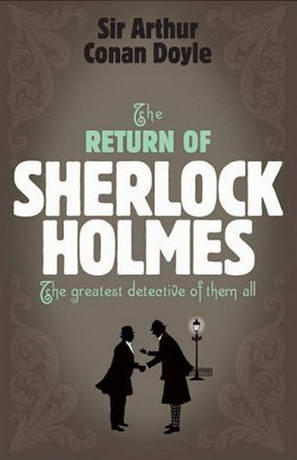
The Return of Sherlock Holmes

By Arthur Conan Doyle
★★★★☆

For today's post, I thought I'd try something new. The standard review format I've been relying on for the past couple years (certainly more sporadically this past year) has felt a little stale lately... whether from lack of readership or just from lack of my own inspiration, I'm not sure. Either way, I thought I might take a little more creative angle on the review thing. Instead of writing a review, I'll write a poem inspired by a few key passages that jumped out at me, or perhaps a particularly poignant scene or character... whatever most inspires me about what I just read. For today's book - The Return of Sherlock Holmes - that was the peculiar (as in both singular/unique and a little bit odd) dynamics of the friendship between Sherlock Holmes and Doctor Watson. Without further ado:

That oh-so-human warm flush
colours your cheeks with pleasure
you cannot/choose not/want not
to conceal; betrays your stoic
self-contained self-generated self-sufficient
pride; proves you to be not immune
(as we - some of us - never I - suspected)
to the spontaneous wonder which springs
from the awed, affectionate regard of a friend.
No, not quite the unfeeling machine
they believe you to be.
I know better. Of course.
I know you better; I have known
the softening of your features
that moves you to hide
your face your self from overexposure
(too raw is it, too unaccustomed
to exposure of any kind).
I have known the impulsive bow,
the irresistible (for you, for us) grin, and that
warm flush of colour oh-so-human
which accompany not the win alone, but
the intimate recognition.

Monday, July 9, 2012

Divergent

By Veronica Roth
★★★★ ☆

Four Things I Liked About Divergent:
1. Tough as nails heroine
2. Dystopian Chicago
3. Four
4. Daredevil feats

Yet another strong series starter. I’ve been hearing great things about this book all year online, but because I didn’t want to make the commitment of actually buying it and because my campus library has a distinct shortage of recent YA releases, I didn’t get around to seeing what all the fuss was about it until now.

Beatrice – or Tris, as she soon becomes – grew up in Chicago, but not the Chicago we all know and love. This Chicago exists some unspecified number of years in the future and, aside from a couple key landmarks like the Sears tower, is unrecognizable. The city is divided into five factions (Candor, Abnegation, Dauntless, Erudite, and Amity), which are like a mixture of vocation and cult. You declare your faction at age 16, and after that your faction becomes your world. If you transferred factions from the one you grew up in (often seen as betrayal), you will no longer live with your family and will only visit them on rare occasions. In a last second decision that surprises everyone except the reader, Beatrice transfers from her family’s faction of Abnegation to the tough and fearless Dauntless. A ruthless and competitive initiation period follows before the initiates can be fully accepted into the faction. As Tris fights for a position in her chosen faction in a competition that blurs the line between even close friend and rival, she struggles with a secret about her identity that may threaten not only her chances at initiation but her life – and the fraying threads that hold her fractioned society together.

Divergent is everything that a good series debut should be: compelling, exciting, inventive. I read the majority of it in about 12 hours. And while I am a fast reader, to put aside all other forms of entertainment to read something that quickly is somewhat rare. But it’s not without its flaws. I felt like book spent too much time focused on the initiation trials which, while interesting, meant that not a ton of ground had been laid for the climaxing of the dystopian subplot, the part where all hell breaks loose. I didn’t feel like I had a very good grasp on the society in Roth’s dystopia – how it worked, why it was formed, what its problems were. Tris’s experiences in Dauntless were very exciting to read, but they didn’t feel very connected to the events unfolding in the society as a whole. Which would have been fine if that’s all the book was, but because the events in society at large became so important in the last chapters of the book, it certainly felt like a weakness that I, the reader, wasn’t better prepared for those events. Feeding the reader more information about the society would also have made the motive behind Roth’s dystopia more clear. Often when a writer creates a dystopia, they are critiquing some system or characteristic of our own society. But what exactly that might have been in Divergent was not clear.

Overall, though, Divergent proves to be a promising beginning to an exciting trilogy. I have the sequel on hold at the library.

Books Read This Year: 54
Top 100 Progress: 48/100

Sunday, July 8, 2012

A Million Suns

By Beth Revis
★★★★★

Five Things I Liked About A Million Suns:
1. Truly surprising plot twists
2. Conspiracy theories
3. World-building
4. Beautiful description
5. Suspense

It’s shaping up to be a summer of series for me, between Across the Universe, Game of Thrones (currently reading book two), and Divergent (review to come). Having read and enjoyed Across the Universe a week or two ago, its already released sequel immediately went into my hold queue at the library. A Million Suns resumes three months after the events of Across the Universe. Eldest is dead; so is Orion. Elder leads Godspeed now, and peopled with free thinkers for the first time generations, the ship stirs with the seeds of unrest. Released from the mind-numbing effects of phydus, the population of Godspeed awakens to the harsh realities of centuries-old Godspeed’s disintegration, and they're not happy with what they see. Meanwhile Amy and Elder delve into the potentially dangerous secrets of the ship’s command and mission – and must take responsibility for whatever they find. As the ship deteriorates into greater and greater disorder, Amy and Elder wrestle with the implications of their newfound knowledge. One thing alone is certain: life on Godspeed is about to change.

A Million Suns achieves a rare feat for a sequel: it manages to improve upon its predecessor. Everything I loved about Across the Universe was present in A Millions Suns, but even better. The plot development was more surprising, more suspenseful, more satisfying. The characters became even more detailed and their relationships richer and more complex. The writing – especially her descriptions of the world outside Godspeed – was even more lovely and luminous. It almost makes me nervous, going into anticipating the third and final book in the trilogy. Will she be able to continue this trend? Will the third book be able to improve on the second as much as the second did on the first? And yet I have no reason to doubt her; so far, Revis has more than shown she can deliver – and then some. I will be eagerly anticipating its release come January!

Books Read This Year: 53
Top 100 Progress: 48/100