Saturday, October 29, 2011

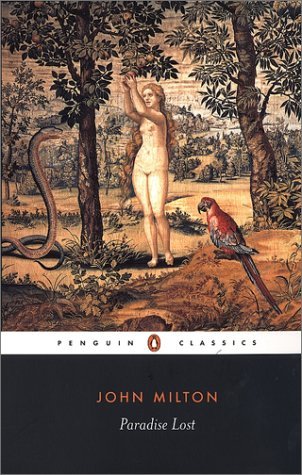
Paradise Lost

By John Milton
★★☆☆☆

Two Things I Liked About Paradise Lost:
1. Finishing it
2. Being able to say I've read it

I have been SO negligent of this blog this year. It's disappointing. I don't like not posting very much. Among other things, I could use the regular writing outlet and practice. But I just... kind of don't have time. Sophomore year has been vastly more time consuming than freshman year. It's all I can do to get my homework done well and in a timely manner, with enough down-time so as not to spiral into a quicksand pit of stress. But I'll do what I can to keep this up! Even though I don't have many readers, this blog is important to me. I like having the record of what I've read and what I've thought about it.

This review is going to be a quickie. I just wanted to get something new up! So. Paradise Lost. Many of you have probably been subjected to this book in either high school or college. That's certainly why I read it, though at times I considered bailing on the effort and succumbing to Sparknotes. (But my academic and bibliophiliac conscience wouldn't let me.) I wanted to give this book one star because it was such a long and unenjoyable slog, but I felt like I shouldn't totally slam it just because it wasn't my taste. I mean, there is some merit to it. Why else would it have withstood the test of time to become one of the most reputable epic poems in the Western canon? Why else indeed.

I feel like I can sum up Paradise Lost in two words: Bible fanfiction. Milton retells the story of Adam and Eve's fall from Eden - starring Satan, and beginning with his fall from Heaven. This poem has everything a good (by which I mean terrible) fanfiction has: sensationalism, revenge, sexual escapades, interpersonal drama not found in the original story... You name it, Paradise Lost has got it. Which is amusing to discuss, but not as amusing as it sounds to read. Milton's language is extravagant and excessively rife with allusions that you may or may not get (in lecture we were told Milton was the most learned man of his time, something which he seems eager to show off), making the poem incredibly dense and arduous to read. His sentences span so many lines that by the end you can't remember what the subject and verb were, and thus have to read the entire thing again.

In short: Not my idea of a good time.

Conversation Starter: Have you ever been subjected to Paradise Lost? If so, what was your experience reading it?

Books Read This Year: 79
Top 100 Progress: 46/100

Saturday, October 8, 2011

Lola and the Boy Next Door

By Stephanie Perkins
★★★☆☆

Three Things I Liked About Lola and the Boy Next Door:
1. Setting – San Francisco!
2. Cameos
3. Friends first

Ugh, again with the ugly cover and the cheesy title. Remember Anna and the French Kiss? Same author. Same packaging problem. If you ask me, Stephanie ought to look into hiring a new designer. (I say this as if the cover is at all within the author’s power, when I’m pretty sure it’s not.) But because I knew what delectable goodness lay within the unappealing exterior of Anna and the French Kiss, I was more than willing to look past the equally off-putting cover of Lola and the Boy Next Door. After all, it’s what’s on the inside that counts. Any kindergartener can tell you that.

Seventeen-year-old Lola lives with her two dads in a lovely old Victorian house in the Castro district of San Francisco. She dresses up head (wigs) to toe in a different costume every day in lieu of “normal” clothes, works in a movie theater, and is pretty sure she’s found The One: a 22-year-old tattooed musician named Max. Her parents disagree. (And who can blame them? Age aside, one mention of Max’s spider web tattoos was enough to make me gag and start the countdown to the inevitable breakup.) Luckily, there wouldn’t be much plot if she were right. Cue Cricket Bell: adorable next door neighbor, childhood best friend, and almost boyfriend until he inexplicably crushed Lola’s feelings and moved away in one fell swoop. Not that she’s harboring a grudge or anything. But two years later when Cricket moves back into the house next door as suddenly as he departed, Lola decides a grudge would be a whole lot easier to handle than the complex poignancy of the rekindled history between them.

Not gonna lie, Lola and the Boy Next Door is exactly what you expect it to be. There are few, if any, surprises. But it is done with more personality and sincerity than many other books of its ilk. It was adorable and satisfying in all the right ways, without losing its dignity or sacrificing depth. Plus it was delightful to see Anna and Etienne again in a new context, and San Francisco was a very fun setting to read about, with the result being that I now really want to go on a trip there. Why aren’t more books set in San Fran?

My qualm: The characters were all more like caricatures than real people. Lola’s costumes, Cricket’s penchant for invention – not to mention being a descendent of Alexander Graham Bell – and his twin sister’s Olympic talent for figure skating, and Max’s semi-successful rock band (of course) all lent a cartoonish air to the story. You would never find all these people together in real life. I think this is the main reason why I wasn't as blown away by Lola and the Boy Next Door as I was by Anna and the French Kiss, though I can't quite put my finger on it. Now that I think about it, though, I guess Anna's characters were somewhat larger-than-life too, but somehow they managed to be so while keeping their authenticity intact; they seemed like real people whereas Lola's characters feel like just that - characters. Nonetheless, the Cricket/Lola development was believable and swoon-worthy, if a tad idyllic. As always, I love how Stephanie’s couples are always first and foremost friends. It’s refreshing. And it makes the eventual relationship ten times more romantic.

Like what you just read? SUBSCRIBE! Register in the bar to your left to sign away your soul get Shelf Life delivered right to your inbox!

Books Read This Year: 73
Top 100 Progress: 46/100

Friday, October 7, 2011

The Lover's Dictionary

By David Levithan
★★★★☆

Four Things I Liked About The Lover’s Dictionary:
1. Concept
2. Word choice (of the entries)
3. Style
4. Ambiguous narrator

I haven’t loved David Levithan’s books in the past – they’re a bit too over-the-top for my taste – so I tend to shy away from them, but The Lover’s Dictionary caught my attention. First of all, look at that cover. Pretty, right? It’s simple and attractive and well suited to the book. It’s a pity how rare that seems to be these days. But more importantly, I was intrigued by the concept. Levithan’s gender ambiguous narrator tells the story of their relationship in a series of vignettes organized under the headings of various dictionary entries.

I think this is best demonstrated by example, so here’s one of the entries:

basis, n.

There has to be a moment at the beginning when you wonder whether you’re in love with the person or in love with the feeling of love itself. 


If the moment doesn’t pass, that’s it—you’re done. And if the moment does pass, it never goes that far. It stands in the distance, ready for whenever you want it back. Sometimes it’s even there when you thought you were searching for something else, like an escape route, or your lover’s face. 

This is, needless to say, not a typical novel. So don’t pick it up expecting the spoony love story of a deserving heroine and dashing prince charming to play out along a traditional narrative timeline. The vignettes give you a series of glimpses into the details of the narrator’s romance, but the entries are not chronological, and the do not give you a complete picture. But that’s, I would argue, the beauty of The Lover’s Dictionary. The vignettes are steeped in detail, but they are also anonymous. The lovers could be anyone; they could be you. And so it isn’t a story to be read, enjoyed, and re-shelved. Because the story is inherently incomplete, and because the anonymity invites you in to take the narrator’s place, it is more like a field guide on love. The unexpected words Levithan chooses for his entries, and the vignettes that explain them, illuminate facets of relationships in surprising, delightful, and insightful ways.

The Lover’s Dictionary is a quick read. Two hours max, and most likely less. So there’s not much at stake if you give it a chance, which I recommend you do. It’s unique and poetic and relevant. I doubt there’s a person out there over the age of 15 who won’t identify with something in these entries.

Books Read This Year: 72
Top 100 Progress: 46/100

Okay For Now

By Gary D. Schmidt
★★★☆☆

Three Things I Liked About Okay For Now:
1. Jane Eyre, the play
2. Library
3. Voice

It’s been a while since I’ve posted, huh? Oops. Excuse: I’m a month into my sophomore year, and it’s been one hectic month. Settling in, scrambling to polish a couple of essays for contests, catching up on homework, starting a new job… It pains me to admit it, but reading and reviewing kind of fell through the cracks. To ease myself back into it, I’ve been reading “easy” books – young adult, and light adult reads. Which is not to say they haven’t been good reads, too! Easy ≠ not good. Remember that.

Things are a little rough for Doug Swieteck. He’s just moved to a new town, he’s got a chip on his shoulder from his abusive father and it’s giving his teachers and classmates the wrong impression, and his eldest brother is coming home from Vietnam. But there’s also Lil Spicer, the spunky daughter of the grocer who hires Doug to make his deliveries, and the library’s copy of Audubon’s Birds of America paintings, which capture his fascination and make his hand twitch with the movements of a phantom pencil, to make him think that even if things aren’t great, they might be okay. For now.

Doug Swieteck is basically Holden Caulfield as a preteen. He’s got the sarcasm, the disillusionment, the catchphrases – “I’m not lying.” He and the other characters are all richly developed; not even the minor characters are three-dimensional and multi-layered. And Doug’s growth throughout the novel is undeniably heartwarming.

But.

There is just too much in this novel, too many conflicts. Spoiler alert: Doug has an abusive father, a bully-in-training as a brother, his eldest brother lost his legs and his sight in Vietnam, he’s ILLITERATE, and then in the LAST CHAPTER, his best friend/girlfriend Lil Spicer gets some kind of potentially deadly never-specified illness (not to mention all the minor things, like having his prized possession, a baseball cap given to him by a famous player, thrown in a gutter by his brother) Like, seriously? That is too much. I mean, I’m sure there are people out there whose lives suck as much as Doug’s or worse, but the paradox of fiction is that it actually has to be more believable than reality. And I just wasn’t buying the freaking deluge of problems plaguing poor Doug.

Books Read This Year: 70
Top 100 Progress: 46/100

Saturday, August 20, 2011

Summer Vacation Reads

I just got back from this summer’s family trip – to Spain! I’d never been before, and it was remarkable to see how different the culture/architecture/landscape/food is there even from the rest of Europe.  It was an exciting, beautiful, and tasty couple of weeks. But as usual, one of the best things about going on vacation was the time I had to read! On this trip, a lot of it was done in the back of a nine passenger van on winding mountain roads, and I realized for the first time that my ability to read through situations like these is a rarity – one I’m very thankful for! As much as I enjoy listening to my iPod and staring out at the landscape, I really don’t know what I’d do with myself if I couldn’t spend a good chunk of my car time plowing through books.

Anyway, instead of writing a full-length review for each of these four of these books, I thought I’d just write a quick summary and a short blurb about my opinion. Sound good? Excellent.

The Cathedral of the Sea
By Ildefonso Falcones
★★★☆☆

This book was a themed birthday present from my dad. The cathedral of the refers to the Santa Maria del Mar cathedral in Barcelona, and my dad fittingly presented this book to me in a restaurant situated in the shadow of that very cathedral. Cool, no?

The Cathedral of the Sea is basically a novelized history of Barcelona during the time the cathedral was built (in only 60 years, lightning speed by cathedral-building standards). And while learning about the city’s history enriched my visit as I walked the streets and saw the sights discussed in the novel, the attempt to turn a historical account into a novel sometimes felt a little heavy-handed as the main characters – the Estanyol family, primarily Arnau and his adoptive brother Joan – experienced all the horrors medieval Spain had to offer, from the feudal system, food shortages, and slavery to the plague, anti-Semitism, the Inquisition. This book is marketed as a rampant bestseller, and once I’d finished it that kind of perplexed me. The story is interesting and peppered with some moving scenes, the writing is competent, and the pace moves along pretty well, but it isn’t remarkably well written, nor is it some kind of addictive or earth-shattering read. So I’m not sure what exactly caused it to be so supposedly successful.

The Prince of Mist
By Carlos Ruiz Zafón
★★★☆☆

You might recognize the name of this author. He wrote one of my favorite books (and the first book I ever reviewed on this site!), The Shadow of the Wind. My sister actually picked this book up at a bookshop in Barcelona when she ran out of books to read (Rule #1 of traveling: never under pack your reading supply). In The Prince of Mist, Max Carver’s family moves to a small seaside town to escape the dangers of city life during World War II. But instead of finding solace and sanctuary, Max and his sister Alicia learn that fist-sized spiders in the attic aren’t the only sinister secrets their new house holds. The more they uncover about the mysteries surrounding the house’s former occupants and their new friend Roland, the more the chilling figure of the Prince of Mist begins to take shape, and the more they realize they’ve stepped into a waking nightmare – one they can’t escape.

As a story written for pre-teens, The Prince of Mist is nowhere near as sordid, complex, and haunting as The Shadow of the Wind. It’s also a really quick read for anyone who didn’t just hit puberty; I read it in 2 hours. But as you would expect from Zafón, the creepy gets creative, and for a children’s ghost story it’s pretty dang creepy (that being said, it doesn’t take much to give me the heebie-jeebies). Overall, though, I confess myself a little disappointed. Even allowing that it’s written for a younger audience and should therefore be a simpler, less complex story, I finished the book wanting… more.

Daughter of Fortune
By Isabel Allende
★★★★★

Eliza Sommers, adopted Chilean daughter of English siblings Rose and Jeremy, falls in love with a poor clerk with wild dreams. When he catches gold fever and ships off to seek his fortune in California, Eliza, pregnant with his child and tormented by her own fever – the fever of love – follows him. Alone, aside from her friend and savior Tao Chien, in a world of unwashed, uncivilized, and unrelenting men, Eliza adopts the persona of a young man in order to survive and devotes herself to the search for her lost love in a country vast and unexplored, a search that becomes a journey of heart, soul, and identity.

Allende spins a good yarn: richly and vibrantly colored, strong, versatile, and carefully woven with attention to detail. She starts with a series of individual fibers, introduces you to each of them, and then begins winding them together until they make a cohesive whole. Still keeping up with my metaphor? No? Okay. Daughter of Fortune isn’t storytelling like many people are used to – the narrative changes voices and moves through time throughout the story until it slowly catches up to itself in time for the conclusion – but it is storytelling at its finest.

p.s. Is it just me, or does that covergirl look uncannily like Catherine Zeta Jones?

Fishbowl
By Sarah Mylnowski
★☆☆☆☆

I read this book under the impression that it was the novel on which the acclaimed movie Fish Tank (which I haven’t seen, but I thought I might after reading the novel inspiration) was based, by confusing fishbowl with fish tank. Needless to say, it wasn’t. I don’t think any kind of acclaim will ever or should ever come from this book.

Fishbowl is the story of how three 20-something roomies accidentally burn down their kitchen and have to earn $10,000 they don’t have to rebuild it since all of them were too negligent and ignorant to buy insurance, which they do by throwing big boozy parties and holding seminars on getting girls to like you. I’m serious. They’re all incredibly vapid, airheaded, depthless individuals who make poor decisions at every opportunity and have no real interests, talents, or purposes in life. Nor were they particularly entertaining narrators, a la Bridget Jones or Meg Cabot heroines. Just one 300-page waste of time.

Conversation Starter:
What have you been reading this summer? Do you go for the light and fluffy beach reads, or do you use your extra time to tackle the meatier stuff that would be too much to focus on during the year? 

Books Read This Year: 64
Top 100 Progress: 46/100

Forever

By Maggie Stiefvater
★★★★☆

Four Things I Liked About Forever:
1. Lyrical language
2. Red font
3. SamandGrace
4. Minnesota!

I’m not nor ever have been much of one for supernatural fiction, other than a brief Twilight obsession three or four years ago (and what few among us girls of a certain age actually escaped that collective craze?) that pretty much peaked and died with the release of Breaking Dawn. I say this so you know that when I recommend Forever and the entire Wolves of Mercy Falls trilogy – about a pack of werewolves living in a forest in Minnesota – you’ll know that it’s actually a deserved recommendation and not the meaningless hype of a girl who spends too much time reading books with moons, fangs, and dark lipstick on the covers.

Forever is the conclusion of a trilogy that began a couple years ago with Shiver, in which Grace, who survived an attack by the local (were)wolf pack in the wooded backyard of her Minnesota home when she was 11 (remember that, it comes back to bite her – heh, heh – in Linger, the second book), had always felt a connection to the wolves in Mercy Falls. But when she meets a boy named Sam with the same ethereal yellow eyes as her favorite wolf, that connection becomes more tangible than she ever expected. Told from the alternating perspectives of Sam and Grace, their romance – with all its implausible canine challenges – is sweet and stirring and poetic, as cozy as a thick sweater on a bitterly cold Minnesotan night. Fast-forward through Sam curing his lycanthropy, Grace succumbing to decade old werewolf venom that was only dormant, never purged, and the addition of several new pack members and narrators in Linger, and you’re pretty much caught up to Forever, minus a couple details here and there.

Forever is not a book you’re going to read if you haven’t read the rest of the trilogy, so I don’t want to go into too much detail. My main purpose in writing this entry is to promote the series as a whole, not one particular book. Forever does what any good trilogy finale should do: it wraps things up, but without doing too neat a job and while still managing to introduce new plot twists, character developments, and conflicts. And it succeeds.

The things I loved about Shiver held true throughout the trilogy, and remain the things I loved about Forever: the lyrical language of Stiefvater’s descriptions, the cozy and heartfelt romance of Sam and Grace, the rich and seamless harmony of setting and story (I loved reading about Minnesota, now being a resident there 9 months a year), the candid – not canned – and characterization, and the anchoring of a decidedly unrealistic story in the unexceptional mundanity of reality. Instead of retreating into some kind of paranormal bubble within reality translucent enough to occasionally glimpse normal life carrying on outside but otherwise mostly impermeable, the characters continue to deal with real-life conflicts even as they’re caught up in their paranormal predicaments. Nor do these books succumb to Disappearing Parent Syndrome, all too common in young adult literature. Stiefvater’s werewolf lore is compellingly realistic, too. Lycanthropy in Stiefvater’s world is a disease – communicable, chronic, and ultimately fatal, but curable, too (by science, not potion-making). And the shifts are triggered by changes in temperature, not the cycle of the moon.

Basically, if you’re a fan of complex characters and realistic conflicts and are turned off by angst and the destructive, all-consuming, inescapable fated love of so many supernatural young adult stories clogging the shelves right now, but value good writing and the occasional creative take on paranormal fantasy, give the Wolves of Mercy Falls a try. If there’s no way you could ever swallow a story about werewolves and humans mingling, steer clear.

Conversation Starter:
Where do you stand on the whole paranormal teen fiction craze? Do you steer clear of it all together, or do you give some of it a chance?

p.s. If you like what you just read, subscribe via email in the bar to the left!

Books Read This Year: 59
Top 100 Progress: 46/100

Tuesday, July 26, 2011

East of Eden

By John Steinbeck
★★★★★

Five Things I Liked About East of Eden:
1. Timshel
2. The slow build
3. Rich and detailed storytelling
4. Evenhanded and thorough characterization
5. Carefully constructed relationships

Steinbeck and I go way back. In 8th grade I read The Pearl and Of Mice and Men, joining my classmates in the thoughtless dismissal of literature a bit beyond our years. When I was a junior in high school, I stayed up later than I ever have before or since to finish a scrapbook-style book report on The Grapes of Wrath (which I managed to like in spite of the indignant loathing inspired by the assignment). East of Eden is the first Steinbeck I’ve read of my own accord which, to be honest, might have as much to do with the fact that this is now my favorite of his works as the novel’s own (prodigious) merit does. Anyone who’s ever been a middle and high school student knows how easy it is to dislike books assigned for class by default, on principle*. Which is a shame, really. Think how many people are wandering around with grudges against perfectly good books simply because they were forced to read them at a formative and obstinate age by teachers who didn’t know how to inspire the right kind of enthusiasm.

But I digress.

If you were to sum up East of Eden in one word, it would be this: Timshel, which means “thou mayest” in Hebrew, and in the novel signifies a man’s freewill to choose between good and evil. East of Eden is laden with biblical imagery (which ought not surprise you, considering the title), but most ubiquitous are the stories of Adam and Eve and Cain and Abel, and the question they pose regarding inherited sin – whether it is an inescapable burden or a birthright to either accept or struggle to throw off. Though there are certainly good and evil characters in East of Eden, the categorization is never so simple and definitive. Every character has good in them, and every character has evil. It’s just a question of the resistance (or lack thereof) involved.

More words to describe East of Eden: gripping, powerful, sweeping, moving.

East of Eden follows several generations of two families – the Trask’s and the Hamilton’s – settled in the Salinas Valley in California, as narrated by a member of the (then) modern generation, who I presumed to be John himself. Whether it is or not doesn’t really matter all that much, however, as most of the attention is given to the first three generations: the patriarchs Cyrus Trask and Samuel Hamilton, their children – the two sons of Cyrus (Adam and Charles) and the Hamilton brood – and their children’s children, mostly Adam’s twin sons Aron and Caleb. The story’s heart is Timshel and the age-old conflict between good and evil, and its outward trappings are the conflicts that arise between and within the two families**. Steinbeck’s knack for portraying the minutia of relationships is one of my favorite talents of his. The subtleties of filial, romantic, and platonic love in East of Eden are carefully and poignantly drawn.

I loved just about everything about this story, but a couple more particulars: I loved the way he built the beginning of the story, introducing various seemingly disconnected characters individually before slowly revealing their connections. In a way, you could say that he creates his own particular brand of suspense, furthered by the fact that the story kept me guessing to the very last page, when the full reality and significance of events built throughout the novel slowly but surely sank in. I was also surprised by just how readable East of Eden is for such a dauntingly sizable book. Once you really get going on it, twenty-five pages go by like nothing. It is an easy read both from the standpoint of being much less dense than you might expect, and from being much more engaging than you might expect.

I feel like for all that it is considered a staple Great American Novel, not that many people have actually read East of Eden. I’d guess they take one look at its spine and assume that it is 1) boring and 2) long and boring. And now that I’ve read it, to me that’s a great pity. I think a lot of people would be pleasantly surprised – both by the book and by themselves – if they just gave it a chance.

Books Read This Year: 58
Top 100 Progress***: 46/100

*In fact, I only remember ever really enjoying a handful of books I had to read for school: And Then There Were None, To Kill a Mockingbird, Jane Eyre, Hamlet, The Great Gatsby and The Grapes of Wrath.
**I know that’s kind of vague, but with books this big it’s actually quite hard to define a single specific conflict.
***How is this not on the Top 100 list? I think this will be one of the few times I will ever say this, but: Stupid BBC and their blatant anglophilia.