Saturday, September 29, 2012

The Perks of Being a Wallflower

By Stephen Chbosky


The Perks of Being a Wallflower is often heralded as the Catcher in the Rye of our generation. It's a cult classic among teenagers, and with the movie adaptation - written and directed by the author himself! - coming out this fall (starring the ever-wonderful Emma Watson), I thought I'd re-read it as a refresher before seeing the film! If anything, I liked it even more the second time around, with a few more years and experiences under my belt. Charlie's voice is simple and authentic, hovering alternatively somewhere between naive and jaded. He thinks just a little too much about the world around him, which causes him problems as a person but makes him a wonderful, perceptive narrator. Most adolescents (and adults thinking back on their adolescence!) will identify with some experience or feeling throughout the book, and that's what has earned it such a large and passionate following. The movie has been described as "nostalgic" and "life-affirming" and these two adjectives apply to the book as well. In keeping with my new blog initiative, I have written another poem for Perks (as it is affectionately called by fans). The most famous line from the book goes, "And in that moment, I swear we were infinite," and I couldn't help but take that as part of my inspiration.

There's a certain infinite quality
of the still lives immortalized
in photography; messy sprawling
jumbled relationships distilled
into their purest moments -
those clear, copacetic moments
when your soul is rushing soaring
swooping, buffeted by the tumult
of the nonstop motion of the world 
spinning and lives living, yet somehow
despite the chaos, you trust this moment enough 
to surrender to it, and in surrender 
a stillness wells within your soul, a quiet calmness
that spreds throughout your body
and fills your heart
and whispers,
"I feel infinite."

There's a certain wistful quality
to happy memories preserved 
in old photographs that makes me wish 
I could live in infinite observation 
of the moments they contain.
A wallflower - if you will - a witness
there to watch, to remember, to participate,
and when we're old or sad or we start to forget
those moments when we were together
and young and oh-so-alive,
it will be my privilege to remind us,
"We were there. We were happy.
And we were infinite."

Tuesday, September 18, 2012

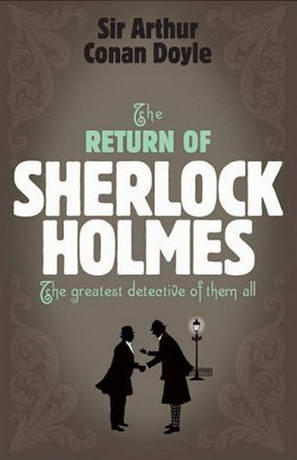
The Return of Sherlock Holmes

By Arthur Conan Doyle
★☆

For today's post, I thought I'd try something new. The standard review format I've been relying on for the past couple years (certainly more sporadically this past year) has felt a little stale lately... whether from lack of readership or just from lack of my own inspiration, I'm not sure. Either way, I thought I might take a little more creative angle on the review thing. Instead of writing a review, I'll write a poem inspired by a few key passages that jumped out at me, or perhaps a particularly poignant scene or character... whatever most inspires me about what I just read. For today's book - The Return of Sherlock Holmes - that was the peculiar (as in both singular/unique and a little bit odd) dynamics of the friendship between Sherlock Holmes and Doctor Watson. Without further ado:

That oh-so-human warm flush
colours your cheeks with pleasure
you cannot/choose not/want not
to conceal; betrays your stoic
self-contained self-generated self-sufficient
pride; proves you to be not immune
(as we - some of us - never I - suspected)
to the spontaneous wonder which springs
from the awed, affectionate regard of a friend.
No, not quite the unfeeling machine
they believe you to be.
I know better. Of course.
I know you better; I have known
the softening of your features
that moves you to hide
your face your self from overexposure
(too raw is it, too unaccustomed
to exposure of any kind).
I have known the impulsive bow,
the irresistible (for you, for us) grin, and that
warm flush of colour oh-so-human
which accompany not the win alone, but
the intimate recognition.

Monday, July 9, 2012

Divergent

By Veronica Roth
 ☆

Four Things I Liked About Divergent:
1. Tough as nails heroine
2. Dystopian Chicago
3. Four
4. Daredevil feats

Yet another strong series starter. I’ve been hearing great things about this book all year online, but because I didn’t want to make the commitment of actually buying it and because my campus library has a distinct shortage of recent YA releases, I didn’t get around to seeing what all the fuss was about it until now.

Beatrice – or Tris, as she soon becomes – grew up in Chicago, but not the Chicago we all know and love. This Chicago exists some unspecified number of years in the future and, aside from a couple key landmarks like the Sears tower, is unrecognizable. The city is divided into five factions (Candor, Abnegation, Dauntless, Erudite, and Amity), which are like a mixture of vocation and cult. You declare your faction at age 16, and after that your faction becomes your world. If you transferred factions from the one you grew up in (often seen as betrayal), you will no longer live with your family and will only visit them on rare occasions. In a last second decision that surprises everyone except the reader, Beatrice transfers from her family’s faction of Abnegation to the tough and fearless Dauntless. A ruthless and competitive initiation period follows before the initiates can be fully accepted into the faction. As Tris fights for a position in her chosen faction in a competition that blurs the line between even close friend and rival, she struggles with a secret about her identity that may threaten not only her chances at initiation but her life – and the fraying threads that hold her fractioned society together.

Divergent is everything that a good series debut should be: compelling, exciting, inventive. I read the majority of it in about 12 hours. And while I am a fast reader, to put aside all other forms of entertainment to read something that quickly is somewhat rare. But it’s not without its flaws. I felt like book spent too much time focused on the initiation trials which, while interesting, meant that not a ton of ground had been laid for the climaxing of the dystopian subplot, the part where all hell breaks loose. I didn’t feel like I had a very good grasp on the society in Roth’s dystopia – how it worked, why it was formed, what its problems were. Tris’s experiences in Dauntless were very exciting to read, but they didn’t feel very connected to the events unfolding in the society as a whole. Which would have been fine if that’s all the book was, but because the events in society at large became so important in the last chapters of the book, it certainly felt like a weakness that I, the reader, wasn’t better prepared for those events. Feeding the reader more information about the society would also have made the motive behind Roth’s dystopia more clear. Often when a writer creates a dystopia, they are critiquing some system or characteristic of our own society. But what exactly that might have been in Divergent was not clear.

Overall, though, Divergent proves to be a promising beginning to an exciting trilogy. I have the sequel on hold at the library.

Books Read This Year: 54
Top 100 Progress: 48/100

Sunday, July 8, 2012

A Million Suns

By Beth Revis


Five Things I Liked About A Million Suns:
1. Truly surprising plot twists
2. Conspiracy theories
3. World-building
4. Beautiful description
5. Suspense

It’s shaping up to be a summer of series for me, between Across the Universe, Game of Thrones (currently reading book two), and Divergent (review to come). Having read and enjoyed Across the Universe a week or two ago, its already released sequel immediately went into my hold queue at the library. A Million Suns resumes three months after the events of Across the Universe. Eldest is dead; so is Orion. Elder leads Godspeed now, and peopled with free thinkers for the first time generations, the ship stirs with the seeds of unrest. Released from the mind-numbing effects of phydus, the population of Godspeed awakens to the harsh realities of centuries-old Godspeed’s disintegration, and they're not happy with what they see. Meanwhile Amy and Elder delve into the potentially dangerous secrets of the ship’s command and mission – and must take responsibility for whatever they find. As the ship deteriorates into greater and greater disorder, Amy and Elder wrestle with the implications of their newfound knowledge. One thing alone is certain: life on Godspeed is about to change.

A Million Suns achieves a rare feat for a sequel: it manages to improve upon its predecessor. Everything I loved about Across the Universe was present in A Millions Suns, but even better. The plot development was more surprising, more suspenseful, more satisfying. The characters became even more detailed and their relationships richer and more complex. The writing – especially her descriptions of the world outside Godspeed – was even more lovely and luminous. It almost makes me nervous, going into anticipating the third and final book in the trilogy. Will she be able to continue this trend? Will the third book be able to improve on the second as much as the second did on the first? And yet I have no reason to doubt her; so far, Revis has more than shown she can deliver – and then some. I will be eagerly anticipating its release come January!

Books Read This Year: 53
Top 100 Progress: 48/100

Tuesday, June 26, 2012

Marcelo in the Real World

By Francisco X. Stork
 ★ ★ ★ ★

Five Things I Liked About Marcelo in the Real World:
1. Lovely, poetic and profound yet realistic dialogue
2. Finely tuned and unique narrative voice
3. Thoughtful characters (as in both caring and full of thoughts)
4. Non-black and white relationships
5. Vermont

How lovely is this cover?? How pathetic is this intro?? Cut me some slack; this is my fifth review in 24 hours. Okay, jumping right in.

Falling toward the more high-functioning end of the autism spectrum, 17-year-old Marcelo has lived his life in the protective environment created by his family and Patterson, the special school he’s attended since kindergarten. He’s looking forward to spending his summer working at Patterson tending the therapeutic ponies before beginning his senior year at Patterson in the fall. But Marcelo’s protected world is turned upside-down by a last minute change of plans when his father tells him he will be instead working in the mailroom of his father’s legal firm. It is high time, his father believes, that Marcelo assimilates into the “real world.” Navigating the ins-and-outs and ups-and-downs of the often tense social and business nuances of the office proves to be the most overwhelming and challenging experience Marcelo has ever faced, but with thoughtfulness, courage, and simple wisdom, it may also prove to be the most rewarding.

It’s hard to read Marcelo in the Real World without thinking of The Curious Incident of the Dog in the Night-time. The stripped-down, keen observations and narration of the autistic protagonists are refreshing and eye-opening. Marcelo may not be encountering anything we haven’t seen before in our own lives, in some capacity, but seeing the “real world” through his un-jaded eyes is a novel experience. The confusion he experiences when he tries to apply his previously uncomplicated logic to the blurry issues of injustice and suffering, selfishness and manipulation, love and desire will strike a chord with all readers, sorry to see his innocence stripped away and sorry for ourselves for having to work out these same issues in our own lives. Marcelo in the Real World inspires empathy as much as sympathy, evoking the bittersweet taste adulthood with all its freedoms, sorrows, challenges, and beauty leaves on the tongue.

Marcelo in the Real World came highly critically acclaimed to my attention, and in my opinion more than lived up to its reputation.

Books Read This Year: 51
Top 100 Progress: 48/100

Monday, June 25, 2012

I am the Messenger

By Markus Zusak
 ★ ★ ★ ☆

Four Things I Liked About I Am The Messenger:
1. “I am not the messenger. I am the message.”
2. “Sometimes people are beautiful. Not in looks. Not in what they say. Just in what they are.”
3. How touching ordinary lives can be, and how ordinary people can touch lives
4. Close-knit friends

Markus Zusak is most well known for being the genius behind The Book Thief. Which is why I was curious to read some of his earlier and modern work. I don’t remember The Book Thief terribly well, having read it right after it came out several years ago now, but based on my vague recollections + the out-and-out ardor the literary community harbors for it, I would venture to say that had I read I am the Messenger when it was first released, I would never have expected that the same writer would go on to produce an opus like The Book Thief. That’s not to say that I am the Messenger was bad, just that it doesn’t have that special quality that has made The Book Thief such a well-loved and critically acclaimed work.

Ed Kennedy leads an unambitious, unremarkably ordinary existence. He drives a cab. He lives in a cheap shack with his smelly, old dog the Doorman as his only companion. On his nights off, he plays cards with his friends and wallows in his unrequited love for his best friend, Audrey. But after Ed accidentally without-really-meaning-to thwarts a bank robbery, things change. He receives a playing card inscribed with three addresses. No names, no dates, just locations. And thus begins Ed’s mission: to visit these addresses and deliver messages to them. Ed is no longer Ed the Ordinary. He is the Messenger. But who is behind his mission? And how will it end?

I am the Messenger is divided into five parts. Through the third part, I had decided to give the book only 3 stars. I wasn’t super impressed. The premise behind the playing card missions seemed contrived and thin, and the overall message of the story (which was clear from like chapter five) a bit too heavy-handed. But the culmination first three parts turned out to be more than they seemed at the time, having set the stage for the much more affective final two parts of the novel. And by the time I reached the end, Zusak had built the story's affectivity such that the final two lines were real zingers, and I am the Messenger had earned that extra fourth star. I’m still not convinced by the premise and think maybe another round of editing – such as tweaking the backstory behind where his missions came from – but the last couple parts of the book had real power to them, enough for me to see why it might’ve earned the Printz Award that figures so prominently on this otherwise pretty lame cover. The Book Thief certainly marks significant growth of Zusak as a writer; it will be interesting to see what he comes out with in the future, whether it lives up to The Book Thief or falls more on level with I am the Messenger.

Books Read This Year: 50
Top 100 Progress: 48/100

Across the Universe

By Beth Revis
 ★ ★ ★ ☆

Four Things I Liked About Across the Universe:
1. Vibrant, imaginative future world
2. Future humans: Will time and technological advancement necessarily change us for the better?
3. Characters
4. Stars

Across the Universe is yet another book I’ve been meaning to read for a while but never got around to actually procuring. Thank you public library. One benefit of being home for the summer: easy access to free books. Not that there’s any dearth of books on a college campus; there’s just a significant lack of YA offerings. Unsurprisingly.

In Across the Universe, Revis imagines a not-too-distant present in which we are capable of cryogenically preserving human life and the world 300 years into the future when a spaceship’s cargo hold full of experts who volunteered to settle a new planet deemed habitable by NASA are scheduled to be re-animated. Amy and her family are part of this group. But when Amy is wakened alone and 50 years ahead of schedule, it becomes clear that all has not gone according to plan on the spaceship Godspeed. Together with Elder, rebellious leader-in-training, Amy discovers just how many secrets can be hidden aboard a sealed ship.

Revis’ imagining of a ship 300 years in our future rings surprisingly realistic. I don’t know by what criteria one could judge such things as “realistic” verses “off base” but somehow the world of Across the Universe just felt really…plausible. I had no qualms about buying into her fiction (unlike, for example, the fiction of Maureen Johnson's The Name of the Star); I stepped readily into the world of Godspeed, happy to observe with curiosity and an open mind.

A miniscule pocket of human life in the vast foreignness of outer space, the world aboard Godspeed is a foreign world unto itself. Revis fills it with customs, accents, advancements, and histories detailed enough to be convincing yet exotic enough to be fascinating. It was easy to see how, given the chain events that had unfurled between the ship’s departure from Earth and Amy’s waking, Godspeed’s society and leadership would have evolved the way it did – making humanity’s classic mistakes adapted by a whole new context and under all-new conditions. It was interesting to look at Earth’s history and beliefs through the eyes of humans who considered themselves far removed (in the most literal way, as well as figurative) and advanced from it. I also enjoyed just the act of imagining Revis’ futuristic world in my mind – how the ship would look and how it would contain imitations of cities and farmland – something she made very easy. The world of Across the Universe was also a colorful one, from Amy’s vibrant red hair (I couldn’t help but picture this Youtuber) to Harley’s paintings to the monoethnic skin tone of Godspeed’s people. Revis’ characters were alluring and interesting, likable even when they were flawed, and above all very, very human.

A strange and beautiful novel. I already have the sequel on hold at the library.

Books Read This Year: 49
Top 100 Progress: 48/100