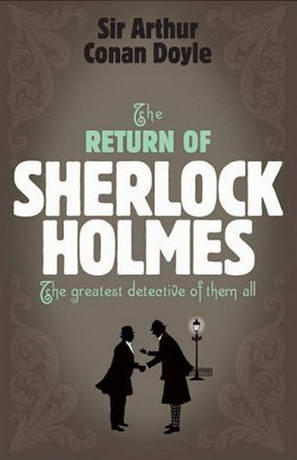
By Arthur Conan Doyle
★★★★☆
For today's post, I thought I'd try something new. The standard review format I've been relying on for the past couple years (certainly more sporadically this past year) has felt a little stale lately... whether from lack of readership or just from lack of my own inspiration, I'm not sure. Either way, I thought I might take a little more creative angle on the review thing. Instead of writing a review, I'll write a poem inspired by a few key passages that jumped out at me, or perhaps a particularly poignant scene or character... whatever most inspires me about what I just read. For today's book - The Return of Sherlock Holmes - that was the peculiar (as in both singular/unique and a little bit odd) dynamics of the friendship between Sherlock Holmes and Doctor Watson. Without further ado:
That oh-so-human warm flush
colours your cheeks with pleasure
you cannot/choose not/want not
to conceal; betrays your stoic
self-contained self-generated self-sufficient
pride; proves you to be not immune
(as we - some of us - never I - suspected)
to the spontaneous wonder which springs
from the awed, affectionate regard of a friend.
No, not quite the unfeeling machine
they believe you to be.
I know better. Of course.
I know you better; I have known
the softening of your features
that moves you to hide
your face your self from overexposure
(too raw is it, too unaccustomed
to exposure of any kind).
I have known the impulsive bow,
the irresistible (for you, for us) grin, and that
warm flush of colour oh-so-human
which accompany not the win alone, but
the intimate recognition.
Showing posts with label poetry. Show all posts
Tuesday, September 18, 2012
Thursday, February 3, 2011
Possession (Top 100 #39)
By A.S. Byatt
★★★☆☆
When my roommate first noticed this book sitting on my desk, waiting to be read, she laughed and thought it to be some kind of mass-market paperback caliber romance novel. With a title like Possession, I don’t blame her! But in fact, Possession resides in a completely different realm of literature. It won Byatt the Booker Prize – England’s highest literary honor – in 1990 and is included in the BBC Top 100 list I’m slowly but surely working my way through*.
I think the fact that the title is so misleading is largely due to the connotations of the word ‘possession,’ which first conjures up notions of obsessive romance. While romance is an integral aspect of Possession, the novel does not limit itself to it but spans the word’s multifaceted connotations.
Possession, n. The act or state of being possessed**; the physical control or occupancy of land, property, etc, whether or not accompanied by ownership; domination, actuation, or obsession by a feeling, idea, etc.
Contemporary scholars of the Victorian poets Randolph Ash and Christabel LaMotte, Roland Mitchell and Maud Bailey are united by academic intrigue when Roland discovers a letter hinting at a hitherto unknown connection between the two poets. The academic investigation that ensues not only overhauls Roland and Maud’s understandings of the poets they’ve devoted their lives to, but overhauls the lives of the academics themselves as the unveiling of the connection between the presumed devoted husband and lifelong spinster becomes increasingly high stakes and personal. As far as that pesky word ‘possession’ and it’s multifaceted connotations, Possession explores the obvious possession rendered by love, as well as the possession of historical documents and artifacts, and even the possession of historical figures by the people who study them – and vice versa.
Depending how you look at it, Possession is either the most theatrical novel about academia you’ve ever read, or the dullest and densest mystery novel you’ve ever read.
My problem with this book is that Byatt interrupts the narrative to insert excerpts from the poets’ epic poems, drafts of their personal letters, and even blurbs from biographies and analytical essays that often went on a bit too long and were – let’s face it –just plain dry. I get why she did this, I really do. She wanted the reader to feel they were immersed in the investigation too; she wanted us to feel as though we knew the poets as intimately as Roland and Maud. But the end result was disruptive and would disengage me every time I really started to be drawn in to the story – and it was a compelling story. I just thought it went on a bit too long.
Now, metaphors and themes and foreshadowing aside, the point of writing a novel – any novel, chick lit, classic, or otherwise – is to tell a story, is it not? And thus it follows that a successful novel is one whose story draws the reader in, whereas an unsuccessful novel fails to do so, resulting in a novel which is an effort of diligence and toil to read. The question, then, becomes: Is a novel successful if it is literarily admirable without being engaging? Conversely, is it successful if it’s engaging without being particularly literarily admirable? I’ll leave you to ponder. If you come up with anything decisive, let me know.
* There's also a movie based on it, but I watched the trailer and I don't think I'll bother watching it. Partly because Aaron Eckhart bothers me, and partly because it just doesn't look good.
** Illuminating, no? I hate definitions that use a different conjugation of the word to explain the meaning of the form in question.
Books Read This Year: 10
Top 100 Progress: 39/100
Labels:
A.S. Byatt,
BBC's Top 100 Book List,
book blog,
book review,
book review blog,
Booker Prize,
college blog,
friendship,
intrigue,
literary questions,
love poems,
poetry,
Possession,
romantic
Sunday, January 16, 2011
The Love Poems
By Ovid
The Love Poems is another example of me opening a book with the wrong set of expectations. Call me crazy, but from a book with both ‘love’ and ‘poetry’ in the title, I expected some romance. And the cover! The cover’s pretty, no? But it was not to be. Ovid is probably one of the least romantic poets I’ve ever read, if you consider an opposite of love to be a vulgarization of romance. Ovid could be described as the Roman man’s guide to Getting Girls, and the Roman woman’s guide to Getting Guys to Like Them. Forget truth or romance; according to Ovid love is all about pretense. And by all appearances, you'd think he's right. The implementation of his advice is still rampant today! Ovid's strategies for wooing women can be observed in frat houses and crude comedies across America on a daily basis, and the contrived charades women employ in their effort to be men’s “ideal” could have been pulled straight from Cosmo’s “25 Ways To Get Him Thinking About You.” A common theme is starting to emerge from all these books* for me: human beings aren’t as dynamic as we think we are. Yeah, we have more advanced technology, take up more space, and live longer than we used to, but our drives and the ways we interact with one another haven’t changed much at all.
In conclusion, I think The Love Poems is a misleading title. All ye romantics, be wary. I’d recommend Ovid only to those who identify with the serial-dating stock male lead in cruder romantic comedies (in need of the reforming powers of blossoming love for the female lead), or perhaps think ‘that’s what she said’ jokes are hysterical. I will concede, however, that although it wasn’t for me, Ovid did have a serious knack for writing poetry.** I just wish he’d channeled his talent into, you know, romantic love poems.
* The ones I’m reading for my J-term class on Romans and Christians, I mean.
** And apparently, so do I. Nice accidental rhyme, eh?
Books Read This Year: 7
Top 100 Progress: 38/100
Books Read This Year: 7
Top 100 Progress: 38/100
Subscribe to:
Posts (Atom)

