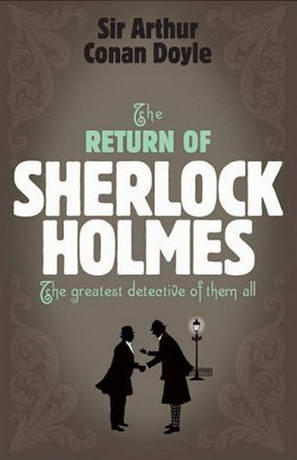
By Arthur Conan Doyle
★★★★☆
For today's post, I thought I'd try something new. The standard review format I've been relying on for the past couple years (certainly more sporadically this past year) has felt a little stale lately... whether from lack of readership or just from lack of my own inspiration, I'm not sure. Either way, I thought I might take a little more creative angle on the review thing. Instead of writing a review, I'll write a poem inspired by a few key passages that jumped out at me, or perhaps a particularly poignant scene or character... whatever most inspires me about what I just read. For today's book - The Return of Sherlock Holmes - that was the peculiar (as in both singular/unique and a little bit odd) dynamics of the friendship between Sherlock Holmes and Doctor Watson. Without further ado:
That oh-so-human warm flush
colours your cheeks with pleasure
you cannot/choose not/want not
to conceal; betrays your stoic
self-contained self-generated self-sufficient
pride; proves you to be not immune
(as we - some of us - never I - suspected)
to the spontaneous wonder which springs
from the awed, affectionate regard of a friend.
No, not quite the unfeeling machine
they believe you to be.
I know better. Of course.
I know you better; I have known
the softening of your features
that moves you to hide
your face your self from overexposure
(too raw is it, too unaccustomed
to exposure of any kind).
I have known the impulsive bow,
the irresistible (for you, for us) grin, and that
warm flush of colour oh-so-human
which accompany not the win alone, but
the intimate recognition.
Showing posts with label Sherlock Holmes. Show all posts
Tuesday, September 18, 2012
Sunday, March 20, 2011
The Adventures of Sherlock Holmes (Top 100 #40)
By Sir Arthur Conan Doyle
★★★★☆
Four Things I Liked About Adventures:
1. Sherlock’s disguises.
2. His contemplative violin playing.
3. “This is a three pipe problem, and I ask you not to speak to me for fifty minutes.”*
4. Catching many of the allusions to the original Sherlock in Sherlock and the recent Robert Downey Jr. remake.
This is Sherlock Holmes like I expected him to be: Sassy, quirky, quick-witted, insensitive, infuriatingly secretive about his thought process, and more concerned with the thrill of the case than the fate of his clients. I accidentally skipped a book in the overall series (The Sign of Four, one of the four novels), but there was clearly a lot of growth in Doyle’s storytelling and character development, and it made the stories that much more enjoyable. If A Study in Scarlet was Sherlock in conception, then The Adventures of Sherlock Holmes is Sherlock fully realized, in all his snarky, brilliant glory.
The Adventures of Sherlock Holmes is a book of short stories, each detailing a single case, as told by Sherlock’s partner in (solving) crime, Dr. Watson**. The installments of the complete Sherlock Holmes series can all be read independently and still make sense, but they also build on one another, with a couple plot threads stretching across several books (and becoming more plentiful as the series go on, I gather) and occasional references to previous cases. While all the stories in Adventures are witty and entertaining, I did, of course, have a few favorites: The Red-Headed League (I covet the hair of gingers, ❤ Weasley family), The Man With the Twisted Lip (an intrigue of identity and disappearing acts), and The Adventure of the Copper Beeches (Bertha Mason isn’t the only woman in the attic***).
The more Sherlock Holmes I read, the more I want to read, because they start off good and get progressively even better. I’ve now decided to read the entire series, and I’m crossing my fingers that my friend gets the complete set for her birthday this week so I can steal borrow them when we get back to campus.
To conclude with a non sequitur: was anyone else aware that Dr. House is supposed to be a re-imagining of Sherlock Holmes? My first thought when I was told was, “Ah… That makes perfect sense.”
* Side note: In the ingeniously adapted BBC series Sherlock (which I mentioned in my post on A Study In Scarlet, and have since finished, and ohmygosh-why-are-there-no-new-episodes-until-next-winter-the-cliffhanger-is-killing-me), Sherlock says instead, “This is a three patch problem,” and shows Watson his arm with three nicotine patches on it. Très clever, non? But that’s Sherlock.
** Another clever adaption by Sherlock (because I’m sure you’re as excited by these as I am) is playing off the form of the stories by having Watson publish a blog about Sherlock’s exploits.
*** Jane Eyre, anyone? Hoping to make a trek to a Landmark theatre here in DC on Tuesday, to see it before I head back to the Midwest, where it doesn’t come out for another week.
Books Read This Year: 23
Top 100 Progress: 40/100
Sunday, March 6, 2011
A Study In Scarlet
By Arthur Conan Doyle
★★★☆☆
Three Things I Like About A Study in Scarlet:
1. Non sequiturs that emerge from Sherlock's internal logic.
2. Sherlock's manic approach to sleuthing.
3. Use of Mormon Salt Lake City as a setting for intrigue.
A couple weeks ago I came across a recommendation for a new BBC drama called Sherlock – a modern adaption of Sherlock Holmes. The series (thus far) consists of 3 90-minute episodes, based on Doyle’s novellas and short stories. I downloaded the first episode, “A Study in Pink,” based on A Study in Scarlet, and loved it.* Being a stickler about reading books before watching their movies and never having read ay Sherlock Holmes before, I decided to spend some time with the genuine article before watching the next two episodes.
A Study in Scarlet is the first Sherlock Holmes story. It begins with the first meeting of Dr. Watson and Sherlock. Dr. Watson is fresh from Afghanistan, having retired from service following an injury and subsequent illness, and is looking for a flat mate. Within 24 hours he and Sherlock have moved into 221 Baker Street and Dr. Watson is embroiled in Sherlock’s latest case – a man found murdered with the ambiguous word “Rache” written on the wall in blood, though the body has suffered no wounds. The mystery spans from the streets of London all the way to the wilderness of the American West, as the backstory unfolds in the fledgling Mormon city of Salt Lake City, Utah.
Like I said, I’ve never had any experience with Sherlock Holmes before. This was a good introduction – being that it is the introduction – but I’ve heard that Doyle’s later stories are much better, and I do have to agree that this one had its flaws. Sherlock didn't say "elementary" even once! And the backstory to the murder is excessive and takes up almost half the novel. I cut Doyle plenty of slack, though, because this was his very first novel and he wrote it in 3 weeks. Plus, how can you really criticize the work of someone who created one of the most iconic characters of all time?**
I enjoyed this novel particularly in juxtaposition with the first episode of Sherlock, which played off A Study in Scarlet without exactly replicating it. I won’t go into details for fear of spoiling either the book or the show, but the general introductory framework of A Study in Scarlet remains intact in the episode, as does the presence of the word “Rache” and the means of murder, though the actual circumstances and motives vary vastly. So if you have the time and interest, I definitely recommend reading A Study in Scarlet (it won’t even take you long, as it’s hardly 100 pages) and then watching Sherlock. I daresay you won’t be disappointed.
I’ll be reading more Sherlock Holmes soon, partly because I’m getting a kick out of him right now, and partly because The Adventures of Sherlock Holmes will be #40 on my BBC Top 100 list. Woot!
* Seriously, it’s awesome. Sherlock is played to perfection, and the modern setting is used surprisingly effectively. It kicks the recent Robert Downey Jr./Jude Law version’s butt. And there’s three times more of it! What are you still doing here?
** Random thought, but I wonder if people will be making television adaptions of Harry Potter in like 100 years. That is, if anyone still watches TV anymore.
Books Read This Year: 20
Top 100 Progress: 39/40
★★★☆☆Three Things I Like About A Study in Scarlet:
1. Non sequiturs that emerge from Sherlock's internal logic.
2. Sherlock's manic approach to sleuthing.
3. Use of Mormon Salt Lake City as a setting for intrigue.
A couple weeks ago I came across a recommendation for a new BBC drama called Sherlock – a modern adaption of Sherlock Holmes. The series (thus far) consists of 3 90-minute episodes, based on Doyle’s novellas and short stories. I downloaded the first episode, “A Study in Pink,” based on A Study in Scarlet, and loved it.* Being a stickler about reading books before watching their movies and never having read ay Sherlock Holmes before, I decided to spend some time with the genuine article before watching the next two episodes.
A Study in Scarlet is the first Sherlock Holmes story. It begins with the first meeting of Dr. Watson and Sherlock. Dr. Watson is fresh from Afghanistan, having retired from service following an injury and subsequent illness, and is looking for a flat mate. Within 24 hours he and Sherlock have moved into 221 Baker Street and Dr. Watson is embroiled in Sherlock’s latest case – a man found murdered with the ambiguous word “Rache” written on the wall in blood, though the body has suffered no wounds. The mystery spans from the streets of London all the way to the wilderness of the American West, as the backstory unfolds in the fledgling Mormon city of Salt Lake City, Utah.
Like I said, I’ve never had any experience with Sherlock Holmes before. This was a good introduction – being that it is the introduction – but I’ve heard that Doyle’s later stories are much better, and I do have to agree that this one had its flaws. Sherlock didn't say "elementary" even once! And the backstory to the murder is excessive and takes up almost half the novel. I cut Doyle plenty of slack, though, because this was his very first novel and he wrote it in 3 weeks. Plus, how can you really criticize the work of someone who created one of the most iconic characters of all time?**
I enjoyed this novel particularly in juxtaposition with the first episode of Sherlock, which played off A Study in Scarlet without exactly replicating it. I won’t go into details for fear of spoiling either the book or the show, but the general introductory framework of A Study in Scarlet remains intact in the episode, as does the presence of the word “Rache” and the means of murder, though the actual circumstances and motives vary vastly. So if you have the time and interest, I definitely recommend reading A Study in Scarlet (it won’t even take you long, as it’s hardly 100 pages) and then watching Sherlock. I daresay you won’t be disappointed.
I’ll be reading more Sherlock Holmes soon, partly because I’m getting a kick out of him right now, and partly because The Adventures of Sherlock Holmes will be #40 on my BBC Top 100 list. Woot!
* Seriously, it’s awesome. Sherlock is played to perfection, and the modern setting is used surprisingly effectively. It kicks the recent Robert Downey Jr./Jude Law version’s butt. And there’s three times more of it! What are you still doing here?
** Random thought, but I wonder if people will be making television adaptions of Harry Potter in like 100 years. That is, if anyone still watches TV anymore.
Books Read This Year: 20
Top 100 Progress: 39/40
Labels:
A Study in Pink,
A Study in Scarlet,
Arthur Conan Doyle,
BBC's Top 100 Book List,
book blog,
book review,
book review blog,
England,
intrigue,
mystery,
poison,
Sherlock,
Sherlock Holmes,
thriller
Subscribe to:
Posts (Atom)
